 Michael Hardin
Key Takeaways
- Hard water scale and food particles close the spray arm holes gradually, so the dishes get dirty in patterns before anything sounds wrong.
- Check the nozzles and clear them with a toothpick once a month; it takes about ten minutes.
- Soak the arms in a white vinegar solution quarterly, then rinse them thoroughly.
- Jetclean Plus arms have fine nozzles that clog easily and need cleaning every three months.
- If the arms are clear and spray is still weak, test the house water pressure and clean the inlet screen.
The Bottom Line
Clear the holes monthly, soak the arms quarterly and keep the filter clean so they do not clog again. If the arms are clear and the dishes are still dirty, look at the water supply next.
A dishwasher can only clean what its spray arms reach, and the arms reach it through a row of small holes that hard water and food particles close, one at a time. Nothing announces it. The dishes simply come out with a gritty film in the places the water no longer lands, and people blame the detergent. Maytag dishwasher spray arm cleaning takes about ten minutes once a month, needs one toothpick and a sink, and keeps the wash pressure close to what the machine delivered when it was new.
| Task | How often | What it prevents |
|---|---|---|
| Check the nozzles and clear them with a toothpick | Monthly | Uneven water, dirty dishes in blind spots |
| Soak the spray arms in a white vinegar solution | Quarterly | Mineral scale and reduced wash pressure |
| Rinse the filter assembly | Monthly | Recirculated food debris |
| Run a dishwasher cleaner cycle | Monthly | Grease, odor and mineral film |
| Descale the interior with citric acid | Annually | Permanent etching on the tub |
Why Do Maytag Spray Arms Clog?
Because the holes are tiny and the water is rarely clean. Our Maytag dishwasher maintenance guide names hard water deposits on spray arms as a leading cause of poor cleaning results and says the Jetclean Plus arms have fine nozzles that clog easily, so it asks for them to be cleaned every three months without fail. Scale builds a little more each cycle, and food bits recirculated through a dirty filter add to it.
The effect is easy to misread. A half-blocked arm still turns and still sprays, so nothing sounds wrong, but the water reaches less of the load. The first sign is residue in a pattern, such as the same glasses coming out cloudy on one side or a plate that is clean on top and gritty underneath.
- Gritty film in blind spots — usually a clogged nozzle rather than a detergent problem.
- A chalky white crust at the holes — hard water scale, visible when the arm is out.
- Dishes that need a second wash — the spray is covering less of the rack than it used to.
How Long Does Maytag Dishwasher Spray Arm Cleaning Take?
About ten minutes for the monthly check and thirty for the quarterly soak, according to the maintenance schedule on our guide. The monthly job is the one that matters, and it is mostly a matter of getting the arms out and looking at them.
- Take out the lower rack — the lower arm is then fully exposed, and the upper arm hangs under the upper rack.
- Remove both arms — your use-and-care guide shows how the arms release on your model.
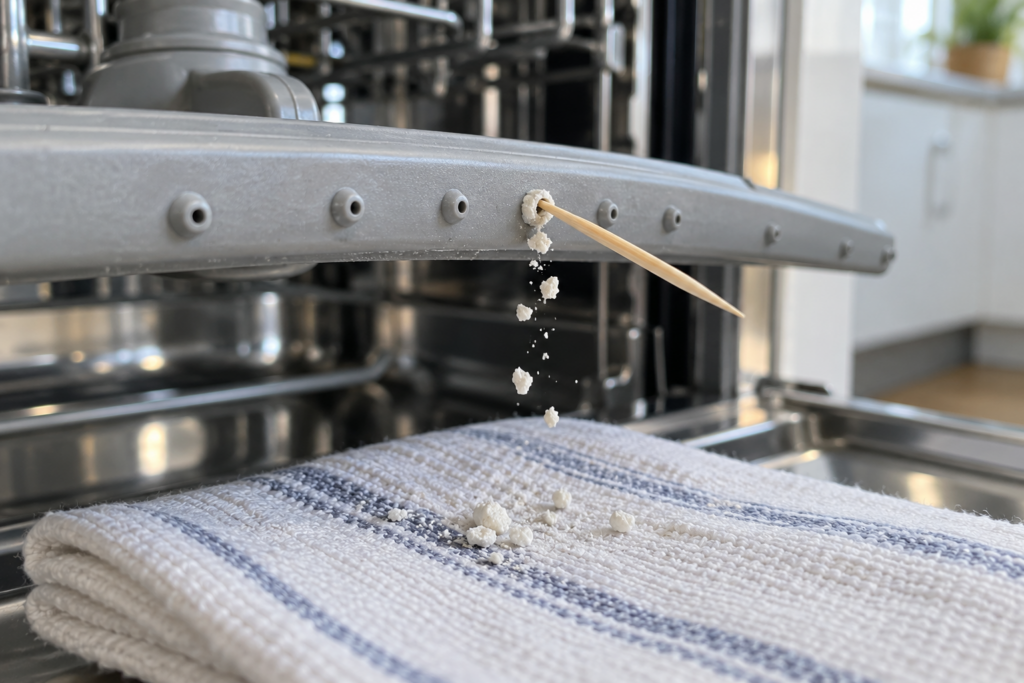
- Clear every hole with a toothpick or a wooden skewer — push the deposit out, working along the whole arm.
- Rinse under running water — shake out any loose debris from the inside of the arm.
- Refit and spin by hand — each arm should turn freely and sit square on its mount.
The Quarterly Vinegar Soak
It is a thirty-minute soak in a solution of white vinegar that dissolves the scale a toothpick cannot reach, and our maintenance guide lists it as the quarterly step for spray arms. Remove the arms, lay them in a shallow dish of the solution, then rinse and clear the holes once more before fitting them back. Use one cleaner at a time, and never mix vinegar with bleach or any other cleaner.
- Soak, then rinse thoroughly — leave no vinegar in the arm, because it will run into the tub on the next cycle.
- Do the filter at the same time — it is a monthly job, and a clean filter keeps the arms from clogging again.
- Follow with a cleaner cycle — an Affresh cycle or a citric acid tablet clears what the arms shed.
How to Tell the Arms Are the Problem
A quick test saves you from cleaning the wrong part. Run a normal cycle with the racks loaded as usual, then look at where the dishes are dirty. A random scatter of dirt points at the filter, the detergent or the water temperature, while a repeating pattern, such as one corner of the upper rack or the underside of the same plates, points at an arm that is not reaching that area.
- Stop the cycle mid-wash — open the door carefully and look at the spray; a jet that is missing or weak from one arm is the clue.
- Look at the arm with a flashlight — chalky crust at a hole or a hole that is visibly smaller than its neighbors is the answer.
- Check both arms — the upper arm is easy to forget, and it serves the glasses that show scale first.
After cleaning, run a hot cycle with a few glasses and judge the result. If the pattern disappears, the arms were the cause and the monthly habit will keep it away. If it does not, move on to the water supply and the filter.
Could Weak Spray Be a Water Problem Instead?
Yes, and it is worth ruling out if the arms are clear and the dishes are still dirty. Our dishwasher F6E2 page describes a water flow rate outside the acceptable limits, with weak or intermittent flow as a symptom, and lists low house water pressure, a partly clogged inlet screen and a failed inlet valve as the causes.
- Test the pressure — the F6E2 page suggests timing a 1-gallon container at the kitchen sink; 60 seconds or less is normal.
- Check the water temperature — our maintenance material suggests running the kitchen tap hot before a cycle, since water below about 120°F cleans poorly.
- Clean the inlet screen — shut off the supply, disconnect the water line at the back and rinse the mesh.
What to Avoid When You Clean the Arms
A few shortcuts do more harm than good, and they are easy to avoid.
- Do not push metal wire through the holes — a toothpick or a wooden skewer clears scale without enlarging or scratching the hole.
- Do not mix cleaners — vinegar, citric acid and a commercial cleaner are used one at a time, and bleach never goes near any of them.
- Do not force an arm that will not release — check the use-and-care guide for your model first.
- Do not skip the filter — an arm cleared of scale clogs again quickly if the filter is full of food.
When Does a Spray Arm Need Replacing?
When it is cracked, warped or no longer turns freely, because no amount of cleaning restores a damaged arm. A cracked arm sprays unevenly and can rub on the rack. A hub that will not spin even after the holes are clear points at a worn mount or a blockage in the sump. If the arms are fine and the dishes are still dirty after a thorough clean, the cause is further along the water path, and our common Maytag dishwasher problems guide takes the diagnosis from there.
The dishwasher repair page lists what a visit covers. You can book a visit or send us the model number and a photo of the arm and we will advise on the next step.