 Michael Hardin
Key Takeaways
- Neptune is a front-load Maytag dryer platform that stopped being built years ago, which changes the repair question from cost alone to parts availability.
- A belt, roller or bearing repair remains straightforward and worth doing on most Neptune dryers, since those wear parts stay reasonably available.
- A dead motor or a failed control board is where a discontinued platform becomes a real obstacle, because sourcing the specific part becomes the deciding factor.
- Ask a technician directly about parts availability before approving any estimate on a Neptune-specific electronic component.
- The mechanical parts of a Neptune dryer are not unusual — the age-related risk is concentrated in the electronics and drive-specific components.
The Bottom Line
A belt or roller repair on a Neptune dryer is almost always worth doing. A motor or board failure is the point to ask directly about parts availability before committing, since sourcing — not cost — is the real risk on a discontinued platform.
A Maytag Neptune dryer repair or replace call looks different from most repair-vs-replace questions on this site, because Neptune is a front-load platform Maytag stopped building years ago, and the question is not just whether a specific part is worth fixing but whether parts and support for the platform itself are worth relying on going forward. The mechanics of a Neptune dryer are not unusual — a drum, a belt, a motor and a heating circuit like any other dryer — but the platform's age changes the calculation around each of them.
| What failed | Typical cause on an aging platform | Repair outlook |
|---|---|---|
| Drum belt slipping or broken | Rubber fatigue from age, common on any older dryer | Usually straightforward to source and repair |
| Drum rollers or bearing noisy | Ordinary mechanical wear | Usually straightforward |
| Motor failed outright | End-of-life wear on an older unit | Parts availability worth checking first |
| Control board or electronics fault | Aging components, discontinued platform | Parts scarcity is the real risk here |
Is a Neptune Dryer Worth Repairing?
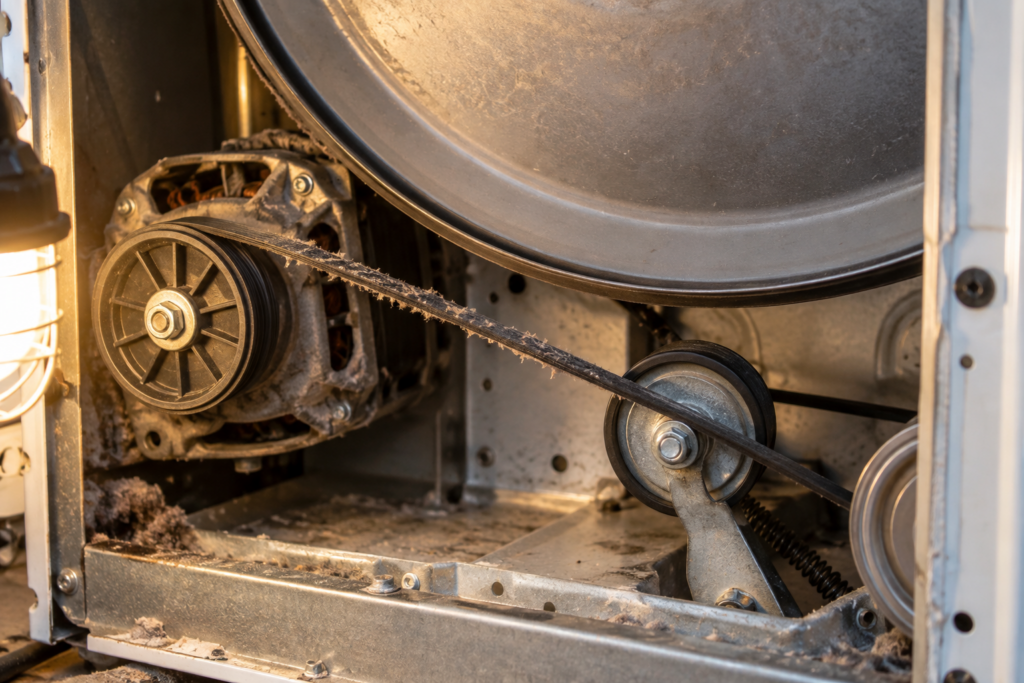
It depends far more on what failed than on the platform's age alone. A belt, a roller or a bearing are common wear parts shared broadly across front-load dryer designs from this era, and they are usually still findable and reasonably affordable to replace — a Neptune with one of these failures is often still worth fixing. A dead motor or a failed control board is a different situation, because Neptune-specific electronics and some drive components have been out of production long enough that parts availability, not repair cost, becomes the real obstacle. For a general sense of what any Maytag dryer repair costs before parts scarcity is factored in, our Maytag dryer repair cost guide gives the baseline this Neptune-specific answer builds on.
Why Does Parts Availability Matter More Here Than on a Newer Dryer?
Because a discontinued platform's parts supply only shrinks over time, and a repair that is straightforward today can become genuinely difficult to source in another few years. This is the central difference between a Neptune repair-or-replace decision and the same decision on a current Maytag dryer: on a current model, the question is almost entirely about cost and labor; on Neptune, the question includes whether the part exists to buy at a reasonable price at all, and that answer changes depending on which specific component failed.
- Mechanical wear parts — belts, rollers, felt seals — remain the most reliably available across older platforms generally.
- Motors and control boards are the components most likely to be scarce or expensive on a discontinued platform.
- A technician who regularly services older machines is worth asking directly about parts availability before committing to any estimate.
- Aftermarket or refurbished parts sometimes fill gaps that original manufacturer parts no longer do, worth asking about specifically.
- A burning rubber smell after the dryer has been running points at a belt slipping against the drum rather than a clean break.
- Vibration that was not there before often accompanies worn rollers well before the thump becomes obvious to the ear.
It is worth being honest about what cannot be said here with confidence: this site does not publish exact production years for when Neptune was discontinued, and guessing at a specific date would be exactly the kind of invented detail this fleet avoids. What can be said reliably is the practical consequence of being an older, no-longer-sold platform — parts get harder to find every year, not easier, regardless of the exact calendar year production stopped. Heating elements and thermal fuses are the other common failure on a machine this old, and they behave the same way here as on any Maytag dryer — a drum that turns normally but produces no heat. That symptom does not carry the same parts-scarcity concern as the drum support system, since heating elements were a widely used design across many Maytag dryer generations.
How Do You Decide Between Repairing and Replacing?
Start with what actually failed before looking at the platform's age at all. A belt or roller repair on a Neptune dryer is close to always worth doing regardless of the machine's history, because it is inexpensive and the parts remain available. A motor or board failure is where the comparison genuinely shifts toward replacement, not because the platform is bad, but because sourcing the specific part reliably becomes the deciding factor rather than the labor cost.
- Get a firm answer on parts availability before approving any estimate on a Neptune-specific electronic component.
- Weigh a mechanical repair on its own merits — belts and rollers do not carry the platform's age-related risk the way electronics do.
- Ask how long the technician expects the repaired unit to keep running, given the platform's overall age.
- Consider a newer dryer's other advantages — efficiency and available features — as part of the decision, not just the immediate repair cost.
For the platform-wide comparison on a current dryer, our Maytag dryer repair or replace guide covers the general decision that this Neptune-specific parts-availability question sits alongside.
Confirming Whether a Dryer Is Actually a Neptune
The Neptune name is usually printed on the console or the front panel, and the model number on the rating plate inside the door frame confirms it against Maytag's older model lineups if the badge has worn off. This matters because a general "older Maytag dryer" is not automatically a Neptune — other discontinued platforms from the same era look similar from the laundry room but carry entirely different parts and service histories.
- Check the front panel or console for the Neptune name printed directly on the machine.
- Confirm with the model number on the rating plate inside the door frame if the name is worn away.
- Do not assume every older front-load Maytag dryer is a Neptune — other discontinued platforms share the same general layout.
- Photograph the rating plate before calling for service, the same way we recommend for any older appliance.
What Makes Neptune Different From a Current Maytag Front-Load Dryer?
Mainly the control electronics and some drive-specific components, not the basic mechanical layout. A current Maytag front-load dryer uses updated control boards and often different motor and drive designs than Neptune did when it was in production, which is exactly why Neptune's board and motor parts have become harder to source over time while the mechanical wear parts — belts, rollers, felt seals — remain common across the broader front-load category regardless of specific platform. Our common-problems guide on common Maytag dryer problems covers symptoms across current models, which is a useful comparison point if you are trying to judge how much a Neptune's issues differ from what a newer dryer would show.
Maytag Neptune Dryer Repair or Replace: Getting a Straight Answer
A belt, roller or bearing repair on a Neptune dryer is usually worth doing without much hesitation. A motor or board failure deserves a direct conversation about whether the part can be sourced at a reasonable price and how long it is likely to last once installed. Our Maytag dryer repair service will tell you plainly which of the two situations you are in before quoting anything.
A diagnostic visit starts from $89, and the final estimate depends heavily on parts availability for this specific platform, confirmed after the on-site look, with a written estimate before any work begins. Book a visit or describe the symptom so we can check parts availability before you commit to anything.