 Michael Hardin
Key Takeaways
- F9E1 on a Maytag dishwasher means a diverter motor fault — a completely different part than the "long drain" F9E1 names on a Maytag washer.
- F6E1, F7E1 and F6E2 all relate to the water path, but a shutoff valve, a flow sensor and an inlet valve are three different checks.
- F8E1 is an open heating element circuit while F8E4 is a stuck relay on the control board — they look identical from the outside but call for different parts.
- F2E2 is usually a stuck keypad button rather than a board failure, and LOC is not a fault at all, just the intentional control lock.
- The same code meaning different things across Maytag appliances is not an exception — always confirm the meaning on the specific appliance's own reference page.
The Bottom Line
Do not assume a Maytag code means the same thing across appliances — F9E1 alone means three different faults on a washer, an oven and a dishwasher. Confirm each code against the dishwasher's own reference page before ordering any part.
Maytag dishwasher error codes follow the same F-and-E pattern as the brand's washers and ovens, and that similarity causes a specific mistake: assuming a code means the same thing everywhere it appears. It does not. F9E1 on a Maytag washer means a long drain. F9E1 on a Maytag oven means a door switch feedback error. On the dishwasher, F9E1 means something else again — a diverter motor fault — and treating it as a drain problem because that is what it means on the washer wastes time chasing the wrong part entirely.
| Code | What the dishwasher reports | Where it points |
|---|---|---|
| F6E1 | No water detected | Inlet valve or supply line |
| F8E1 | Heater fault, not heating | Heating element circuit |
| F7E1 | Flow meter fault | Water flow sensor |
| F9E1 | Diverter motor fault | Diverter, not the drain pump |
| F6E2 | Water flow out of range | Flow meter or inlet valve |
| F3E1 | Wash pump/motor fault | Main wash motor |
| F2E2 | Stuck key on control panel | Touch panel |
| F8E4 | Heater relay stuck | Control board relay |
| F0E1 | UI-to-main control communication | Board-to-board link |
| LOC | Control lock engaged | Intentional, not a fault |
Does F9E1 Mean the Dishwasher Will Not Drain?
No — on a Maytag dishwasher specifically, F9E1 is a diverter motor fault, not a drain failure. The diverter is the part that switches water flow between the lower and upper spray arms during a cycle, and when its motor fails or loses its position feedback, the control raises F9E1 even though the drain pump itself may be working perfectly. This is exactly the kind of code that gets misdiagnosed by anyone who has seen F9E1 mean "long drain" on a Maytag washer and assumes the same meaning carries over. Our Maytag dishwasher F9E1 reference covers the diverter specifically.
F6E1, F7E1 and F6E2: The Water Path Faults
These three all relate to water getting in and being measured correctly, but each points somewhere different. F6E1 means no water was detected at all — the most common causes are a closed supply valve under the sink or a kinked line behind the machine. F7E1 is a flow meter fault, meaning the sensor that measures water entering the tub is not reporting correctly, independent of whether water is actually flowing. F6E2 means flow was detected but outside the range the control expects, which can be either the flow meter or a partially restricted inlet valve.
- Check the shutoff valve under the sink first for F6E1 — a valve nudged closed during other plumbing work is the single most common cause.
- Look for a kinked supply line behind the dishwasher on any fill-related code.
- Do not assume a flow code means the pump is failing — flow codes are about the inlet side, not the drain side.
- Clean the inlet screen if fill is slow rather than absent, since sediment collects there over years.
None of these three fill and flow codes should be confused with the more general complaints covered in our guide to common Maytag dishwasher problems, which walks through symptoms without a code showing at all — a genuinely different starting point than the specific fault numbers this article covers.
F8E1 and F8E4: Two Different Heater Faults
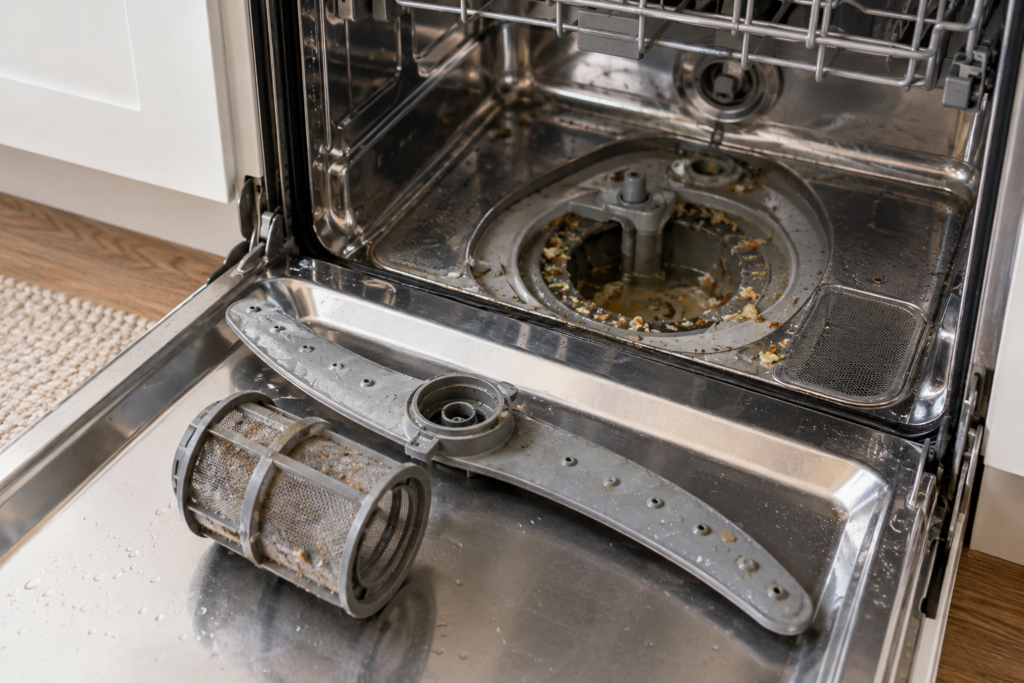
F8E1 is a heater fault reporting that the water is not heating at all, which typically means an open circuit in the heating element itself. F8E4 is a heater relay stuck condition — a fault on the control board's switch for that same element, not the element itself. The practical difference matters because F8E1 usually calls for element replacement while F8E4 calls for board work, and the two symptoms can look identical from the outside: dishes come out at the wrong temperature either way.
- Feel the tub water temperature partway through a cycle if it is safe to check — consistently cold points at either fault equally, so this step alone will not separate them.
- Note whether the code appears every cycle or intermittently. A relay stuck condition can be intermittent in ways a fully open element circuit is not.
- Do not run heated dry with either code active until the fault is diagnosed.
- Check the element for visible damage or discoloration if it is safely accessible, before assuming the relay is at fault.
A meter test is really the only reliable way to tell these two apart, since both present as a dishwasher that finishes a cycle with lukewarm or cold water and no other obvious symptom. A technician checks the element for continuity first, since that rules F8E1 in or out directly, and only then moves to the relay circuit that would explain F8E4.
Is F2E2 Just a Stuck Button?
Usually, yes — F2E2 means the control has detected a keypad button that appears to be held down continuously, and it is most often a membrane touch panel that has taken years of steam and moisture from the door vent. F0E1 is a different kind of electrical fault: a communication failure between the user interface board and the main control board, meaning the two boards that should be talking have stopped, independent of any single button or key.
LOC is not a fault at all. It means the control lock feature is switched on, disabling the keypad intentionally so a cycle cannot be interrupted accidentally, especially useful with children in the house. If LOC will not release after holding the lock combination for several seconds, that points toward the same touch panel hardware behind an F2E2 fault, not toward a new problem.
Which of These Codes Can You Check Yourself Before Calling for Service?
Three of the ten codes above are worth a homeowner check before anyone books a visit: F6E1, F6E2 and LOC. Everything else on this list sits behind the tub wall or the control panel, wired into circuits that are not safe or practical to open without training, so the useful homeowner step for those is simply writing the code down accurately rather than attempting to trace it further.
- F6E1 or F6E2: check the shutoff valve and the supply line for a kink before assuming a part has failed.
- LOC: hold the lock combination for several seconds; if it will not release, note that for the technician rather than forcing the panel.
- Any other code on this list: write it down exactly, note when in the cycle it appears, and stop the cycle rather than letting it run repeatedly.
- Any code that keeps returning after a full power cycle: that pattern alone is useful information, so record it before calling.
General upkeep such as running the preventive diagnostic checks we cover for the dryer applies in spirit to the dishwasher too — catching a slow-forming problem before it becomes a hard fault is worth the five minutes it takes.
Getting It Checked
Supply valves, kinked lines and inlet screens are fair homeowner checks. The heating element, the diverter motor, the flow meter and the control boards sit behind the tub wall and the control panel, wired into both the water sensing circuit and the mains supply, which is where the job stops being homeowner territory. Our Maytag dishwasher repair service covers the full water and heat circuit in one visit.
A diagnostic visit starts from $89, and pump or motor work on these machines starts from $139. The final price is confirmed after the on-site diagnosis, and a written estimate comes before any work begins. Book a visit with the code written down, or send us the code and the point in the cycle where it appears.