 Michael Hardin
Key Takeaways
- Centennial machines span several control generations: some show a two-character code, others signal a fault with a cycle status light.
- Write the code down before cancelling — most clear on reset, and a cleared code tells a technician nothing.
- oL, uL, Sd and Int describe the load or the interruption, not a broken part.
- LF and F21 are the two that point at real hardware: supply valves and inlet screens on fill, filter and pump on drain.
- A code names the system that failed a measurement, never the part that failed.
The Bottom Line
Note the code, then decide whether it is about the laundry or the machine. Load and suds codes are solved in the laundry room; a fill or drain code that survives a clean filter and clear hoses needs a diagnostic.
Centennial washers were built across several model years and more than one control generation, which is why owners describe the same machine in two different ways. Some show a short two-character code where the estimated time normally sits. Others have no numeric display at all and report a fault by holding or flashing one of the cycle status lights. Either way the vocabulary is the same, and the list of Maytag Centennial washer error codes below is taken straight from this site's own washer archive rather than from a forum thread.
| Code | What the control measured | Where to look first |
|---|---|---|
| dL | Lid did not lock within 3 minutes | Lid rim, latch receiver, lock assembly |
| dU | Lid did not unlock within 3 minutes | Lock assembly and its wiring |
| Sd | Excessive suds detected | Detergent type and dose |
| LF | Long fill — legacy code | Supply valves, hoses, inlet screens |
| oL | Overloaded drum | Load size, not the machine |
| uL | Unbalanced load | Distribution of heavy items |
| F21 | Long drain — legacy platform | Filter, drain hose, pump |
| Int | Cycle interrupted | Pause, lid opening, power blip |
First Work Out How Your Machine Talks
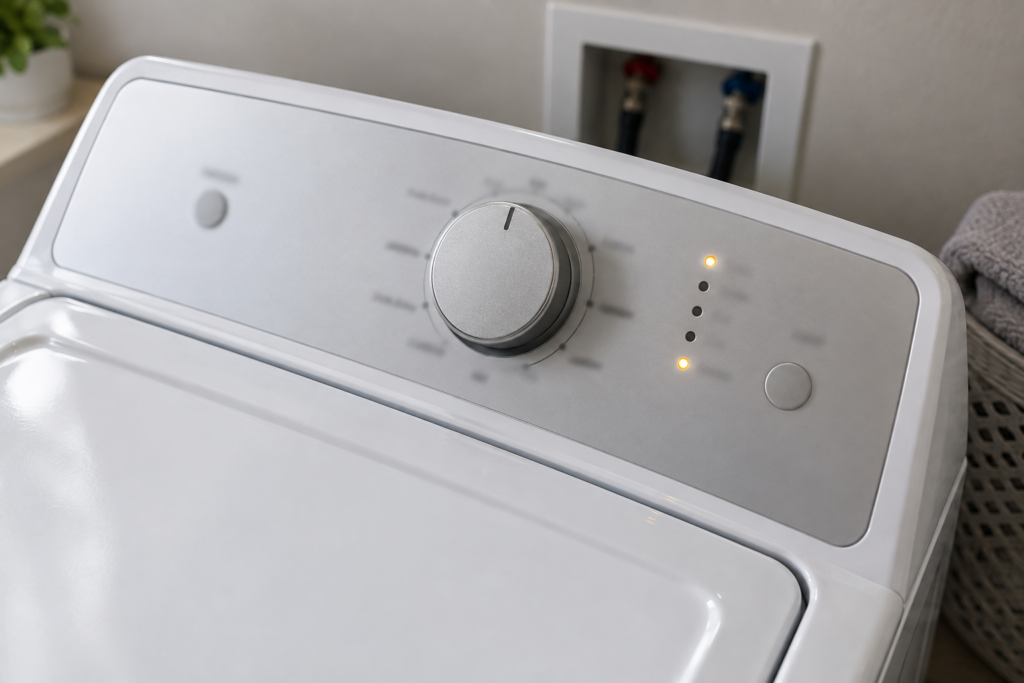
Before chasing a code, establish which kind of console you have. If there is a digital readout, the code appears there and you can write it down. If there is only a column of cycle lights, the machine signals faults by lighting or flashing one of them, and you will be reading a pattern rather than characters. A machine that only pauses with a lit status light is not broken in some undocumented way — it is reporting in the vocabulary it has.
Write down what you saw before you cancel anything. Most codes clear when the cycle is cancelled or the power is cut, and an owner who has already reset twice arrives at the service call with no information at all.
Half of These Are About the Load, Not the Machine
Four entries in the table describe the washer reacting correctly to something outside it. oL and uL are about load size and distribution. Sd is about foam, and foam is almost always detergent choice rather than a fault — our guide to the Sd suds code covers that one on its own. Int means the cycle was interrupted.
- Stop adding detergent to fix poor cleaning. Extra detergent makes suds, suds defeat the pump, and the cycle stretches out.
- Wash one bulky item with a couple of towels. A single comforter has nowhere to sit when the drum spins.
- Redistribute rather than restart. Pulling the load apart by hand fixes uL faster than any cycle setting.
- Treat a repeat as a symptom. Correct loads that still post oL or uL point at the suspension or the basket, not at the laundry.
Fill and Drain Are Where Real Faults Live
The two codes worth taking seriously on this list are LF, a long fill, and F21, a long drain on the legacy platform. Both mean the control measured time against an expected event and the event did not happen. Both have causes you can reach and causes you cannot.
- For LF, check the taps first. A half-open hot valve or a kinked hose will do it, and so will a clogged inlet screen at the back of the machine.
- Then check both hoses. A washer filling from one supply only will take roughly twice as long, which is exactly what the control is complaining about.
- For F21, clear the drain filter. Coins, lint and hair pack it slowly, and the machine is often fine again once it is clean.
- Check the standpipe height and depth. A drain hose pushed too far down siphons, and one kinked behind the machine throttles the pump.
- Listen during the drain phase. A hum with no water moving means the impeller, silence means the pump motor.
If the filter and hoses are clear and water still stands in the tub, stop there. Our guides on a Maytag washer that will not drain and on what a draining problem costs pick the story up at that point.
What a Code Does Not Tell You
Every code on this list describes a measurement, not a broken part. F21 says the drain took too long. It does not say whether the filter is packed, the hose is kinked, or the pump has failed, and those three have very different bills attached. The same goes for dL: the lid lock never confirmed, but whether that is a sock under the rim or a dead actuator is still an open question.
This is the single most useful thing to understand about a Centennial-era machine. The code narrows the search to one system. It does not name the part, and any list that claims otherwise is guessing on your behalf.
It also explains why two owners with the same code get two different answers. One clears a filter and never sees it again; the other replaces a pump. Both were right about their own machine, and neither story predicts yours. Work through the checks in order and let the machine tell you where it stops, rather than buying the part somebody else needed.
When to Stop and Call
Stop when the checks above are exhausted and the code returns, when the machine posts a code you cannot find in the archive, or when the drum bangs on spin rather than simply posting uL. Bearing and suspension work is not a Saturday job — it means splitting the machine — and our Maytag washer repair service covers it along with the pump and lock circuits.
Diagnostic work starts from $89, with the final price confirmed after the on-site diagnosis and a written estimate before any work begins. Bring the code you wrote down: it saves the technician a cycle. You can book a visit or send us the details, and if you are weighing the repair against a new machine, our repair-or-replace guide is the better place to start.