 Michael Hardin
Key Takeaways
- A Maytag service call starts from $89 and covers the visit, code reading, component testing and a written report.
- The repair is a separate line, quoted in writing after the fault is found and before a part is ordered.
- Our diagnostics page says the fee is credited toward the repair if you proceed on the same visit; confirm it before booking.
- Labor usually accounts for 40 to 60 percent of a Maytag repair total, so access and time matter as much as the part.
- Photograph the model plate and note when the code appears to make the visit shorter.
The Bottom Line
Treat the visit fee as the price of a named fault and a written estimate. Do the free checks first, bring the model number and the code, and compare the repair quote against the price of a new machine.
The first bill on any appliance repair is the visit itself, and it is the one people are least sure about: what it pays for, whether it counts toward the fix and what happens if the repair turns out not to be worth doing. A Maytag service call cost is really two numbers, the fee for finding the fault and the price of fixing it, and keeping them apart is the easiest way to judge any quote. This guide sets out the first number in full and shows the second at the level of typical washer repairs.
| Stage | What it involves | Starting price |
|---|---|---|
| Service call and diagnosis | Visit, code reading, component testing and a written report | from $89 |
| Drain pump replacement | Washer will not drain, F9E1 | from $145 |
| Lid lock replacement | Lid will not lock, F5E1 | from $145 |
| Main control board | Control board or F-code faults | from $235 |
| Tub bearing and seal | Noisy spin, the most labor-heavy washer repair | from $450 |
How Much Does a Maytag Service Call Cost?
A Maytag service call starts from $89, which is the flat rate our diagnostics page quotes for the visit. The fee covers travel, inspection, reading the fault codes and the written report, and our page states there are no hidden charges on top. The price of any repair that follows is a separate line, quoted in writing after the fault is found and before a part is ordered.
The figures in the table come from our Maytag washer repair cost guide and show how quickly the second number moves with the part. A drain pump and a lid lock sit at the cheap end, a control board is in the middle and a bearing, which needs the drum taken apart, is the most expensive.
What Does the Service Call Cover?
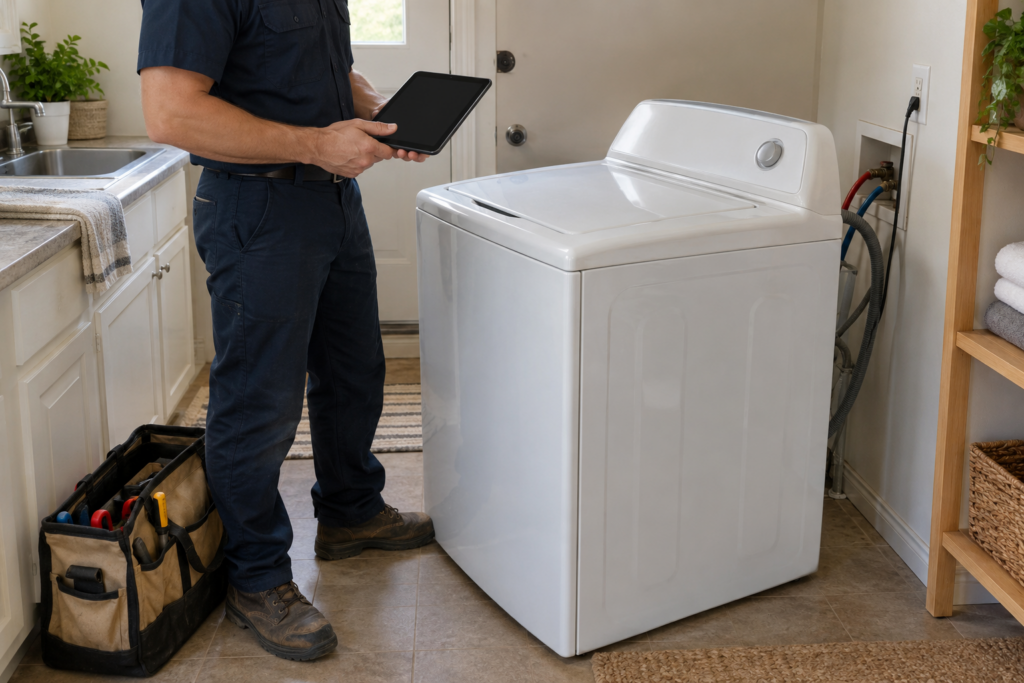
It covers a full in-home diagnostic visit that ends with a named fault. Our appliance diagnostics page lists what that means: reading and interpreting the error codes using the factory protocols, inspecting the mechanical, electrical and control-board components, and documenting the confirmed fault in a written report. The technician also gives a firm repair estimate before any part is ordered and advises on repair against replacement based on the age of the appliance and part availability.
- Code reading — the stored code points at a subsystem, such as the load-sensing circuit on a F0E1, rather than naming a part.
- Component testing — sensors, actuators and boards are tested, so the part that is replaced is the one that failed.
- Wiring and connector inspection — corrosion and heat damage are checked before a board is blamed.
- A written findings report — it names the fault, the recommended repair and the part.
Is the Visit Fee Credited Toward the Repair?
Our diagnostics page says the fee is credited in full toward the repair if you proceed on the same visit, and our general repair cost guide advises confirming that policy before you book. If you decide not to go ahead, the fee has still paid for the visit and the diagnosis, which is the information you are buying.
That is the useful way to think about the fee. It is the cost of knowing what is wrong, and it is worth paying even when the answer is that the washer should be replaced, because you leave with a named fault and a written estimate rather than a guess.
What Changes the Final Price After the Visit?
Four things move it, in roughly this order of impact. Our Maytag appliance repair cost guide says labor usually accounts for 40 to 60 percent of the total on a Maytag repair, which is why access and time matter as much as the part.
- Which part failed — a lid lock is a quick swap, while a bearing means complete disassembly of the drum.
- Platform — front-load bearing access is harder than top-load, and older Neptune-era machines face scarce parts.
- Labor rate — it varies by region, and the guide cites rates from $85 per hour in most US markets.
- Whether the cause is still there — a drain pump killed by a coin fails again if the hose is not cleared, so the visit should end with the cause removed.
Our washer draining problem guide shows the same logic on one common fault, with the free checks listed before any part.
Three Visits, Three Outcomes
The same fee leads to very different totals, and seeing the paths side by side makes a quote easier to read. These are illustrations of how the pieces fit together, not predictions for your machine.
- The free fix — the washer will not drain, and the technician finds the pump filter packed with lint and a coin. The filter is cleared on the spot. You pay for the visit and nothing else, and you leave knowing what to check next time.
- The contained repair — the pump has failed. The fee is credited toward a pump replacement that starts from $145, and the written estimate is agreed before the part is ordered.
- The replacement conversation — a much older washer has a noisy bearing. The visit confirms the diagnosis, and the written estimate sits beside the price of a new machine so you can decide with the facts.
In all three the visit does the same job: it turns a symptom into a named fault. The difference is what the fault turns out to be, and that is why the fee and the repair are best judged separately.
What a fair quote looks like. A fair quote is specific. It names the part that failed, shows the part and the labor separately, and says whether the visit fee is credited. Our washer cost guide also suggests asking whether a bearing diagnosis has been confirmed before accepting a bearing quote, because a thump in the spin cycle can be a loose counterweight or an object in the drum rather than a worn bearing.
- A named part — "drain pump" or "lid lock", not "washer repair".
- The evidence — a code, a meter reading or a visible failure that supports the diagnosis.
- The credit, stated — whether the visit fee is applied to the repair.
- The comparison — a sentence on repair against replacement for the age of the machine.
Getting More From the Visit
A few minutes of preparation shorten the visit and sharpen the diagnosis, and they cost nothing.
- Photograph the model and serial plate — the technician can have the right part information ready before arriving.
- Write down the code and when it appears — before the cycle, during fill or at spin each point at different circuits.
- Do the free checks first — a cleared drain filter or a straightened hose can make the visit unnecessary.
- Ask for an itemized estimate — part, labor and any access or travel charge on separate lines.
- Ask about the warranty on the repair — parts and labor warranties vary, so get the terms in writing.
If the appliance is still under the manufacturer's warranty, check that route before paying; our Maytag warranty guide explains what is covered and when a professional is needed.
Booking the Visit
The final price is confirmed after the on-site diagnosis, with a written estimate before any work begins. Our washer repair page lists what a washer visit covers. You can book a service call or send us the model number and the symptom and we will tell you which checks to try first.