 Michael Hardin
Key Takeaways
- F1E1 is the one code that names the main control board; F2E1, F3E1 and F7E1 usually have cheaper causes.
- A recent storm or outage makes F1E1 almost certainly surge damage, which means a new board.
- Capacitors dry out or swell after about five to eight years, so board age matters as much as washer age.
- Maytag washers average 10 to 14 years of service, and a single board repair on a younger machine is usually worth doing.
- Repeated board failures, or a board failure alongside a bearing or transmission fault, are reasons to replace.
The Bottom Line
Rule out the touchpad, the air dome tube and the speed sensor before you condemn the board. Repair a first surge-related failure on a washer under 10 years old, and replace after repeated board failures.
A Maytag washer that stops at random points, flickers its display or lights several indicators at once makes owners reach for the same conclusion: the control board has died, and the whole machine is finished. That conclusion is correct less often than it feels, because three other codes produce a very similar impression and none of them involves the board at all.
| Code | What it names | Is the board involved? |
|---|---|---|
| F1E1 | Main control board fault | Yes — the one that really is the board |
| F2E1 | Stuck key on the touchpad | Usually the touchpad, moisture or debris |
| F3E1 | Pressure sensor out of range | Usually the air dome tube or the sensor |
| F7E1 | Basket speed sensor fault | Usually a coupler, belt or the sensor |
Is It Really the Maytag Washer Control Board?
Only when the code is F1E1, or when the washer throws several unrelated codes with no pattern. F2E1, F3E1 and F7E1 all look like electronic failures from the outside, but each has a cheaper cause that should be ruled out first, and replacing a board that was never at fault is the most expensive mistake on this list.
- F2E1, stuck key: water, soap splash or cleaning product under a button, a failed membrane switch, or an impact to the panel.
- F3E1, pressure sensor: a clear air dome tube that has slipped off its port or is kinked or clogged with soap, or a failed sensor.
- F7E1, speed sensor: a sheared plastic motor coupler on Bravos top-loaders, a snapped drive belt on Maxima front-loaders, or the sensor itself.
- F1E1, main board: corrupted firmware, a failed capacitor, or moisture that reached the control housing.
What Does F1E1 Mean on a Maytag Washer?
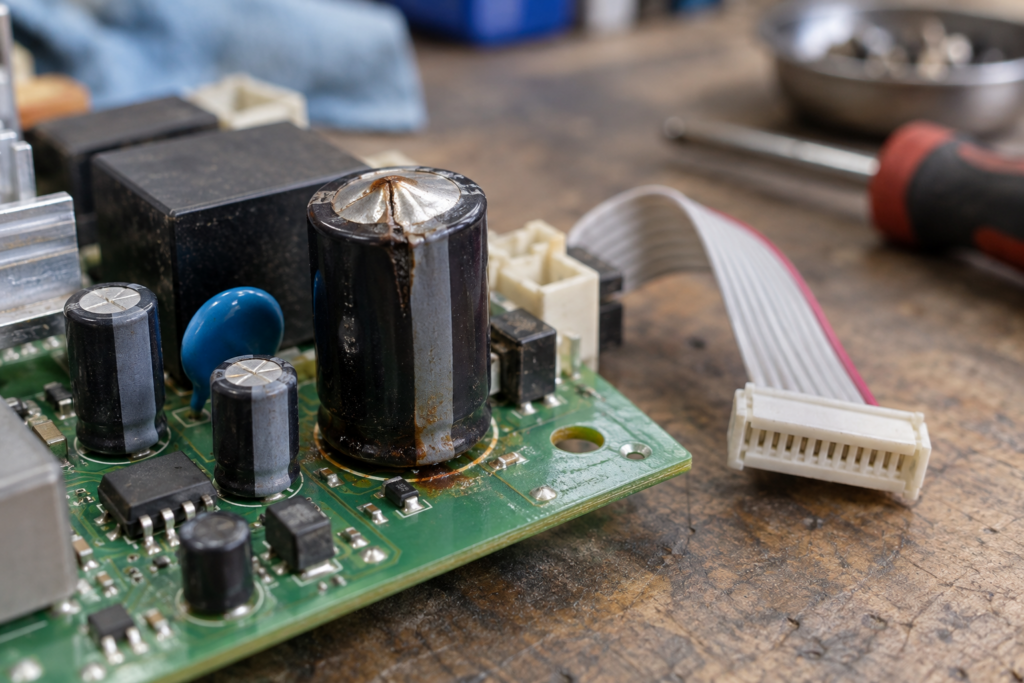
F1E1 means a fault inside the main electronic control board on Bravos XL, Maxima and MVWB washers. The control has detected an unexpected condition, usually a corrupted memory read, a failed capacitor or moisture damage, and it halts to prevent unpredictable behavior. This site rates it high severity, and it is not safe to keep using, because a faulty control can run heating, draining or spinning when it should not.
The symptoms are random rather than repeatable. The washer stops mid-cycle at inconsistent points, the display flickers or freezes, several indicator lights come on in patterns that match no cycle, and a different phase is affected each time. A hard reset may clear it briefly, but the fault remains and the code returns.
Does a Power Surge Change the Answer?
Yes, because a recent thunderstorm, brownout or outage makes F1E1 almost certainly surge damage, and surge damage means a new board. A power surge corrupts the stored program, which is the most common cause after a lightning strike. Capacitors are the other usual story: they dry out or swell after about five to eight years of use.
That timing is the useful part for this decision. A surge on a machine that was otherwise healthy is a one-off, and a replacement board on a washer under ten years old can restore it for years. A capacitor failing at the eight-year mark on a machine with other wear is a different picture. A surge protector on the laundry circuit prevents a repeat, so ask about one when the board goes in.
Maytag Control Board Repair or Replace: The Deciding Factors
Four factors decide it, and they come from the framework on our parent guide, Maytag washer repair or replace. A control board sits on the core-component side of that guide's line, which is why it deserves more scrutiny than a pump or a belt.
- The estimate against the 50 percent line. Compare the written quote with half the price of a comparable new Maytag washer.
- The age of the washer. Maytag washers average 10 to 14 years of service, and past year 10 any board repair deserves closer scrutiny.
- The repair history. Two or more paid repairs in 18 months is the clearest sign that replacement will cost less over time.
- The cause of the failure. A one-time surge is easier to forgive than a board that has failed twice, which the guide lists as a reason to replace.
Repeated control board failures are named as a replace trigger alongside transmission and bearing failures. A single board on a younger machine is not.
It helps to picture two owners. The first has a seven-year-old Bravos that stopped mid-cycle the morning after a thunderstorm and shows F1E1 with no other history, and a replacement board is a sensible repair on that machine. The second has a twelve-year-old washer that has already needed a pump and a lid switch in the last year and now shows a board fault, and the repair history says replacement will cost less over time. The code is the same, but the answer is not.
How Many Board Repairs Are Too Many?
More than one in a short span. A first board replacement after a documented surge is a reasonable repair, but a second board fault, or a board fault arriving alongside a bearing or transmission problem, is the point where most owners should price a new machine.
- First board failure after a surge, machine under 10 years: repair.
- Board failure with moisture damage from a leak: fix the leak first, then repair if the rest is sound.
- Second board failure, or board plus bearing or transmission: lean toward replacement.
- F2E1, F3E1 or F7E1 diagnosed as a touchpad, tube or coupler: repair, since the board was never the problem.
What to Ask Before Approving a Board
A board is a part you can ask questions about, and the answers tell you whether the diagnosis was careful. Our is it worth repairing a Maytag washer guide and our Maytag washer repair cost guide give the wider context for the estimate you receive.
- Which codes were stored, and whether F2E1, F3E1 or F7E1 appeared before the board was blamed.
- Whether the touchpad, air dome tube and speed sensor were checked, since each is cheaper than a board.
- Whether moisture is present in the control housing, because a leaking hose can ruin a second board if the leak is not fixed.
- What the repair is warranted for, so a repeat failure is covered rather than paid for twice.
Getting a Diagnosis Before You Decide
The most useful thing you can do is have the code read and the look-alikes ruled out before anyone quotes a board. Our Maytag washer F1E1 page lists the safe checks, including the 10-minute unplug reset and the power-history question, and our Maytag washer repair service tests the sensors, the coupler and the board in order.
A diagnostic visit starts from $89, and the final price is confirmed after the on-site diagnosis, with a written estimate before work begins. Book a visit or send us the exact code and how old the washer is, and we will tell you which side of the line it usually falls on.