 Michael Hardin
Key Takeaways
- Commercial Technology on a Maytag washer means a reinforced transmission and suspension, not a separate commercial-grade appliance line.
- A transmission or suspension repair on this line is usually a good investment, since those are exactly the parts the branding strengthens.
- A control board or electronics fault on one of these washers should be judged the same as on any standard Maytag washer.
- This line is generally worth repairing well past the point a standard washer's owner might weigh replacement, as long as only one system has failed.
- Several unrelated failures close together still favor comparing against a new washer, regardless of the Commercial Technology branding.
The Bottom Line
A transmission or suspension repair on a Commercial-branded Maytag washer is worth approving in most cases, because those are the parts built for heavier use. A board or electronics fault deserves the same evaluation as on any other Maytag washer.
Whether it is worth repairing a Maytag Commercial washer usually comes down to whether the heavier-duty parts that carry the Commercial Technology name are actually the ones that failed, or whether the failure is in a part no different from any other Maytag top-load washer. Commercial Technology is a durability marketing name Maytag applies to certain washers built with a stronger transmission and reinforced suspension components — it does not describe a separate commercial-grade appliance line sold only to laundromats, and that distinction matters for what a repair actually involves.
| What failed | Is it the "commercial" part? | Generally worth repairing? |
|---|---|---|
| Transmission or drive components | Yes — reinforced under this branding | Usually yes |
| Suspension or shocks | Yes — reinforced under this branding | Usually yes |
| Control board or display | No — same as standard models | Usually yes |
| Multiple major systems at once | Not relevant to this question | Worth comparing to replacement |
Is a Maytag Commercial Washer Worth Repairing?
Yes, in most cases — the entire reason Maytag markets certain washers with heavier-duty commercial-grade parts is that those parts are built to be repaired and to keep running rather than replaced at the first sign of wear. A transmission or suspension failure on one of these machines is not a sign the washer has reached the end of its useful life; it is closer to the fatigue any mechanical part eventually shows after years of heavy use, and the reinforced parts underneath the marketing name are specifically the ones designed to be worth that investment.
What Does "Commercial Technology" Actually Change?
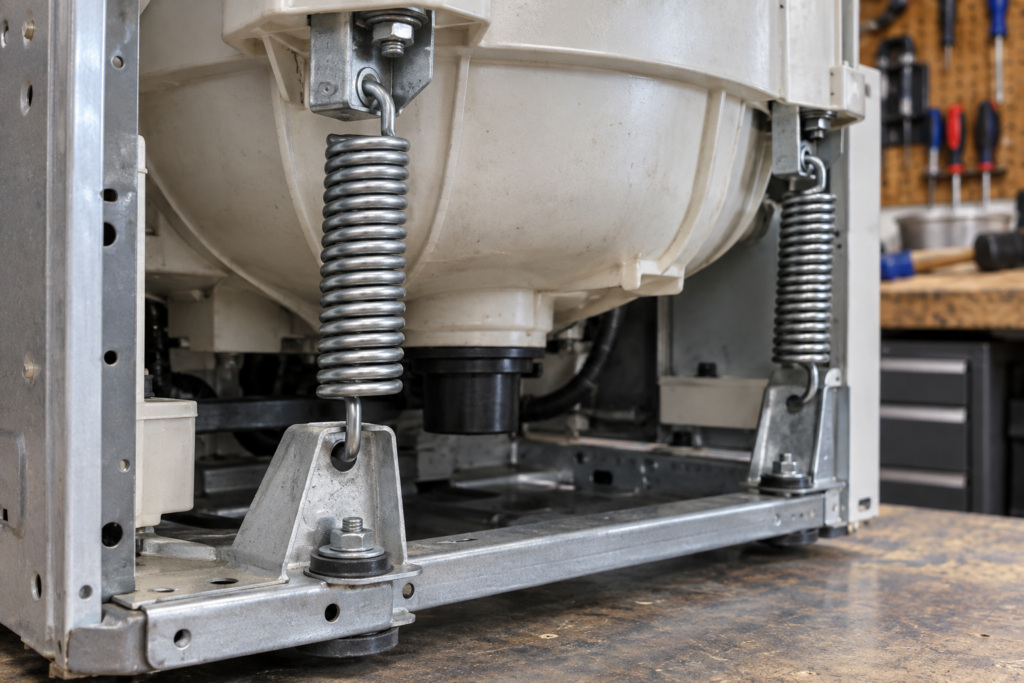
It changes the transmission and the suspension components primarily, not the electronics or the basin. Maytag's commercial-grade branding on certain residential washers signals a stronger drive train intended to handle heavier and more frequent loads without the same wear rate as a standard model — this is not a different washer built for laundromats, but a residential machine built with sturdier internals under the hood. That distinction is exactly why a control board fault or a display issue on one of these washers is no different a repair question than on any other Maytag washer: the reinforcement does not extend to the parts that were not the weak point to begin with.
- A transmission or suspension repair on this line is generally a good investment, since those are the parts the branding specifically strengthens.
- A control board or electronics fault should be judged the same way it would be on any standard Maytag washer.
- Do not assume the branding means a longer overall lifespan for parts it was never designed around.
- Confirm the badge against the rating plate rather than assuming from appearance alone, especially on a machine bought secondhand.
- Check parts availability before assuming a quick turnaround, since a reinforced transmission is not always the same part number as a standard model's.
The badge itself is usually visible on the console or lid area, and confirming a machine actually carries this designation is worth doing before assuming any of the above, since Maytag has sold multiple washer lines with overlapping appearances over the years. A model number check against the rating plate settles it reliably.
Does the Washer's Age Change the Answer?
Yes, but less than it would on a standard washer, precisely because the parts most likely to fail on this line were built with extra durability in mind. A machine that is otherwise running well and needs one repair — even a labor-heavier one such as a transmission — is usually still worth fixing well past the point where a standard washer's owner might start weighing replacement. The calculation changes only when several systems fail close together, the same threshold that applies to any washer regardless of branding.
- One failing part on an otherwise sound machine favors repair, especially if that part is the transmission or suspension.
- Several unrelated failures within a short window favors comparing against a new washer, same as any platform.
- Ask specifically which part failed before assuming the "commercial" durability applies to the repair in question.
Do not confuse this question with our separate guide on Maytag Commercial Technology repair or replace, which weighs the branding's durability claims across appliances generally — this article is specifically about whether a Commercial-branded washer's own repair is worth approving. For the platform-wide washer decision, our is it worth repairing a Maytag washer overview covers the broader picture this article's transmission and suspension questions sit inside.
Confirming Whether a Washer Actually Carries This Branding
Check the console or the top panel for the Commercial Technology name printed directly on the machine, and confirm the model number against Maytag's own published lineup if the badge is worn or missing — the branding is specific to certain model families rather than applying broadly across every Maytag top-load washer built in a given year. This matters before assuming any washer automatically has the reinforced parts this article discusses.
- Look for the branding on the console first — it is usually printed clearly rather than a small sticker.
- Check the full model number against the rating plate if the badge is unclear or has worn off.
- Do not assume every heavy-duty-looking top-load washer carries this specific branding — Maytag also sells standard top-load washers without it.
What Symptoms Suggest the Transmission or Suspension, Specifically?
Weak or absent agitation with spin still working normally points at the transmission, while a washer that walks, vibrates heavily, or bangs during spin points at the suspension — both are the reinforced systems this branding is built around, and both are generally worth the repair investment discussed above.
- Weak agitation, normal spin — transmission or its internal clutch.
- Excess vibration or walking during spin — suspension or shock absorbers.
- Grinding tied to drum motion regardless of cycle stage — worth a full inspection rather than guessing between the two.
Our guide to Maytag washer repair costs covers what each of these specific repairs runs once diagnosed, which is worth reading alongside this article's worth-it question rather than in isolation.
Getting a Straight Answer for Your Machine
A transmission or suspension repair on a Commercial-branded Maytag washer is usually a sound investment, precisely because those parts were built with heavier use in mind. A control board or display fault deserves the same evaluation any Maytag washer repair would get. Our Maytag washer repair service diagnoses which system actually failed before quoting anything.
A diagnostic visit starts from $89, and the final price for whichever part is involved is confirmed after that on-site look, with a written estimate before any work begins. Book a visit or describe the symptom and we will confirm which system is actually affected.