 Michael Hardin
Key Takeaways
- A Maytag washer transmission repair starts from $325 and is a labor-heavier job than most washer repairs because reaching it means removing the drum.
- Weak or absent agitation with normal spin points at the transmission; a roar only during spin points at the separate tub bearing instead.
- The transmission and the tub bearing are different parts with different failure signatures, even though both are among the pricier washer repairs.
- This repair is usually worth it on a machine otherwise running well, but the cost tier is worth weighing against the washer's overall age first.
- Transmissions are frequently sold only as part of a larger assembly, which is part of why this is not a realistic DIY repair for most owners.
The Bottom Line
A transmission repair starts from $325 and is worth doing on a washer that is otherwise sound — the key is confirming it really is the transmission and not the tub bearing before approving the estimate.
Weak agitation, speeds that change oddly between cycle stages, or a grinding or whining noise that tracks with the drum's motion is what usually puts a Maytag washer transmission repair cost on the table, rather than a code on the display. The transmission is a distinct part from the tub bearing — a sealed unit inside the tub that fails from water intrusion — and confusing the two leads to the wrong estimate before a technician even looks at the machine.
| Symptom | Likely part | Typical cost tier |
|---|---|---|
| Weak or absent agitation, drum still turns for spin | Transmission | Higher — gearcase job |
| Grinding or whining tied to drum motion | Transmission bearing or gears | Higher |
| Roar during spin only, agitation normal | Tub bearing (separate part) | Higher, different job |
| Drum will not turn at all, motor hums | Drive belt or pump, not transmission | Lower |
How Much Does a Maytag Washer Transmission Repair Cost?
A transmission repair on a Maytag top-load washer starts from $325. This is a labor-heavier job than most washer repairs because reaching the transmission usually means removing the drum and disconnecting the drive components around it, not simply swapping a part visible from underneath. The final price is confirmed after the on-site diagnosis, and a written estimate is provided before any work begins — that confirmation matters here specifically, because transmission symptoms overlap enough with other faults that the estimate can shift once the machine is actually opened.
Whether the machine is belt-drive or direct-drive changes what the technician checks on the way to that diagnosis, and it is worth knowing which type is under your own cabinet before the visit. A belt-drive top-load washer has a visible rubber belt looping a pulley beneath the tub, and a slipping or snapped belt produces symptoms that mimic a failing transmission for a fraction of the repair cost — from $95 rather than from $325 — so it is always checked first. A direct-drive machine skips that step entirely, since the motor couples straight to the transmission with nothing in between to rule out cheaply.
Is This the Same as the Tub Bearing Problem?
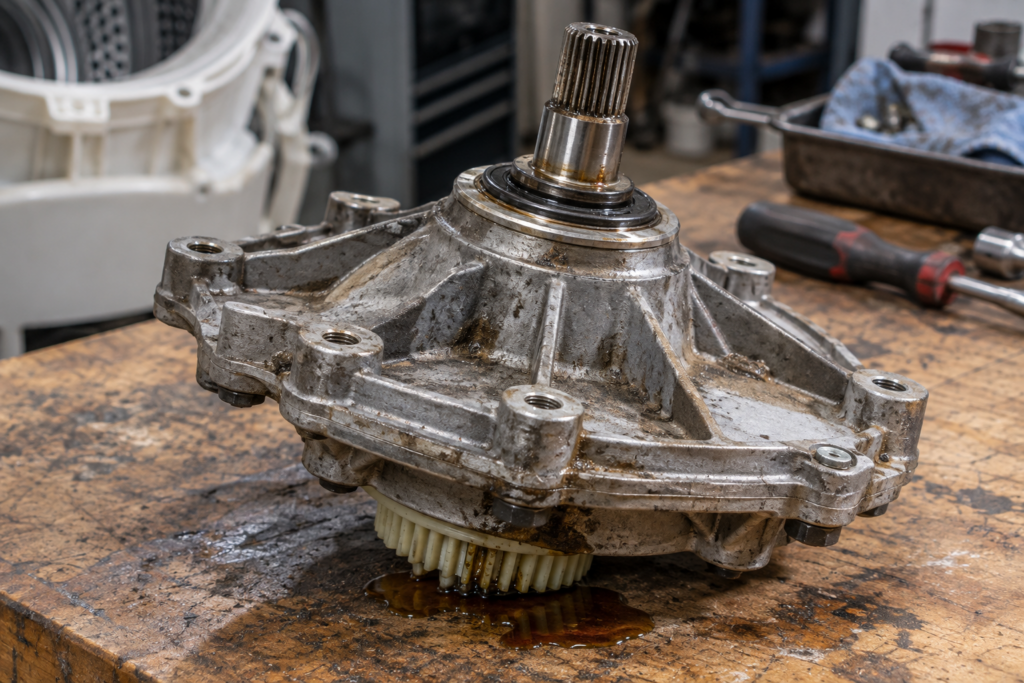
No — these are two different parts with two different failure signatures, even though both live inside the same washer and both are pricier repairs. The transmission converts the motor's rotation into the washer's agitate and spin motions and typically fails from gear wear or a worn clutch mechanism inside it, producing weak agitation or unusual cycle-stage behavior. The tub bearing, covered separately in our guide to Maytag washer repair costs, is a sealed bearing that supports the outer tub and fails from water intrusion, producing a roar specifically during spin with agitation otherwise normal. A machine could theoretically need both, but it is far more common for only one to be failing, so identifying which symptom is present narrows the estimate substantially before a technician arrives.
- Weak agitation with normal spin points at the transmission or its clutch.
- A roar only during spin, with normal agitation points at the tub bearing instead.
- Both symptoms together on an older machine are worth a full inspection before committing to either repair alone.
- Check for a visible belt under the cabinet on belt-drive models — a loose or broken one is the cheapest possible explanation.
- Smell for burning rubber after a failed spin attempt, which points at a slipping belt rather than a stripped transmission gear.
Is a Transmission Repair Worth the Cost?
Usually yes, on a machine that is otherwise running well and reasonably within its expected service life, because the transmission failing is a mechanical wear issue rather than a sign the rest of the washer is following it into failure. The size of the bill is what makes this repair worth a moment's pause compared with a cheaper part: at this cost tier, it is fair to weigh the repair against the washer's overall age and condition rather than approving it automatically the way a part swap from $95 might be.
- Ask how old the washer is before approving a transmission-tier repair.
- Check whether other parts have needed replacement recently — a transmission failure alongside other wear is a different conversation than an isolated fault.
- Get the diagnosis in writing before assuming the noise is definitely the transmission and not the bearing.
- Ask what the warranty on the repaired part covers going forward.
What Actually Causes a Transmission to Fail
Ordinary mechanical wear is by far the most common cause, not a manufacturing defect or misuse. Internal gears and the clutch mechanism inside the transmission wear gradually with every cycle, the same way any mechanical gearbox wears over years of use, and on a top-load washer running several loads a week, a decade or more of that wear is a normal outcome rather than a sign of a defective part. Overloading the washer repeatedly accelerates this wear more than any other single habit, since the transmission has to work harder against a heavier, more unbalanced load on every cycle.
- Years of regular use is the baseline cause — this is a wear part, not a part that should last the life of the washer.
- Habitual overloading accelerates wear on the gears and clutch faster than moderate loads do.
- Running unbalanced loads repeatedly without correcting them adds stress with every cycle.
None of this is covered in our broader guide to common Maytag washer problems, which focuses on symptoms rather than the specific mechanical cause behind a transmission failure — the two guides are meant to be read together if the cause matters as much as the fix.
Can a Transmission Be Replaced at Home?
Not realistically for most owners. Beyond the mechanical difficulty of pulling the drum and disconnecting the drive train correctly, transmissions on these machines are frequently sold only as part of a larger assembly, and reassembly out of sequence is a common cause of a second, more expensive visit. This is squarely a professional repair rather than a weekend project, unlike simpler jobs such as replacing a drain hose or a lid switch.
- Pulling the drum requires removing the top panel, the console and often the outer tub straps first.
- The drive train has to be disconnected and reconnected in the correct order, which is easy to get wrong without documentation specific to the model.
- A transmission sold as part of a larger assembly can cost more in parts alone than the labor most owners expect to pay.
Getting It Checked
A quick way to help narrow the estimate before a technician arrives: run one wash cycle and note specifically whether agitation feels weak or absent, versus whether the noise is only present during the spin stage. Either way, our Maytag washer repair service diagnoses the transmission against the bearing and the drive components before quoting the job, and if the diagnosis points instead toward a repair-or-replace decision for the whole machine, our is it worth repairing a Maytag washer guide covers that broader comparison.
A diagnostic visit starts from $89, and transmission repair starts from $325 once confirmed on site, with a written estimate before any work begins. Book a visit or describe when the noise happens in the cycle.